Showing posts with label six nations championship. Show all posts

Monday, July 5, 2010

Six Nations Championship: Borthwick dropped from England rugby squad


Steve Borthwick former's captain, who led England in the last Six Nations championship, has been left out of the 32 man elite squad for next season announced by national team manager Martin Johnson on Thursday.
The 30 year old Saracens lock captained the side in 20 Tests over two years until injury forced him to hand over to Lewis Moody for the final Six Nations game against France and the subsequent summer tour down under.
To the second string Saxons squad he is noe demoted where he is joined by wing Ugo Monye, centre Mathew Tait, lock Louis Deacon and hooker Lee Mears who are also discarded from the elite.
The uncapped Gloucester lock Dave Attwood takes Borthwick's place alongside the other three locks - Tom Palmer, Courtney Lawes and the evergreen 36 year old Simon Shaw.
Johnson said, "Leaving Steve Borthwick out was a very hard decision". "He's done a fantastic job for England over the last couple of years and it's the most difficult call we've had to make.
"It is very tough on Steve but it goes to show the depth of talent we've got in that area.
"We want to build on what we've done this summer and a southern hemisphere tour that was hugely beneficial and a actually positive experience for the pair.
"We were able to give lots of opportunities to players and expose them to a high level of rugby."
Leicester scrum half Ben Youngs and prop Dan Cole have been officially included among the elite after establishing themselves in the Test team during the tour of Australia and New Zealand.
Wasps' uncapped centre Dominic Waldouck has also been included at the expense of Tait along with Leeds' South African born flanker Hendre Fourie and Gloucester prop Paul Doran Jones.
Having taken over the captaincy from Borthwick, leading England to a 21-20 victory in the second Test against Australia in Sydney last month, Moody now looks likely to spearhead England's World Cup campaign in New Zealand next year.

Wednesday, April 21, 2010

Friday start for Six Nations


England and Wales will kick-off their 2011 RBS Six Nations Championship campaigns with a Friday night match in Cardiff.
The two rivals will kick-off next year's tournament at the Millennium Stadium on Friday February 4.
Two previous games have been played on Friday evening, with Wales losing 21-16 to France in Paris in 2009 and Les Bleus winning the fixture in Cardiff this year.
However this will be the first time that the championship has started on a Friday.
Defending champions France will kick-off their challenge on Saturday February 5 against Scotland, with a home game against Wales to round off their campaign on Saturday March 19.
England have three successive home games against Italy (February 12), France (February 26) and Scotland (March 13), before they finish up with a trip to Ireland.
Scotland host Wales and Ireland in rounds two and three and finish with another home game against Italy.
Wales visit Italy in round three and host Ireland two weeks later.
Six Nations Tickets are available online on GigSport.

Monday, November 9, 2009

They are building for success, England yet to prove


Likely without ever intending it, the most damning analysis of England’s performance at Twickenham on Saturday came not from any analyst or expert or writer with finely poisoned quill, it came from Rocky Elsom, the Australia captain.
When asked to what extent he and his team mates had to battle to keep out England, how much hard work and backs-against-the-wall stuff was required to defend their tryline, to stop England from going for the jugular, Elsom said that his team had to work very hard in defence, but he added: “I didn’t feel we were really stretched.”
England may have been going for the jugular, but, as Elsom attested, the home team did not clap eyes on it all day. England are again building, waiting, preparing for greater things, yet appear to remain stuck in a perpetual state of waiting, building and preparation.
There is a Groundhog Day feeling to the start of these autumn series at Twickenham. England start averagely, they perform honestly, valiantly but undazzlingly and then deliver the reminder that that was just the start. That was pretty much the form on Saturday. And it has been pretty much the history of the England team, yes, ever since 2003.
If you plotted a progress curve from that date, it would be flat. There appeared to be an upward turn towards the end of last season’s RBS Six Nations Championship but that seems a blip rather than a foundation from which further improvement may be made. It is all very well to draw a line in the sand and say, “from here we go forward”, but England, for once, need to build momentum and keep it.
Martin Johnson, the team manager, said: “That is the first game this side has played together and we will be better for it for next week.” And quite right, they should improve for Argentina on Saturday.
Yet there seemed less patience in the approach to building and rebuilding from Robbie Deans, the Wallabies coach. “If you look at our experienceacross the board, our cap count is not that high, either,” he said. “But it doesn’t really matter. People don’t really care how many caps you have or how old you are, they expect you to perform.”
Given a choice of the two, who would not prefer the Australian way? On Saturday they threw in a new centre partnership and they delivered on Day 1. And Will Genia, the scrum half, is so fresh to this game that he was buzzing afterwards, not about having beaten England but because he had met Jonny Wilkinson. “I’ll go home and tell my family, ‘I played against Jonny Wilkinson and shook his hand,’ ” he said.
It would, though, be preposterous not to recognise the unusual circumstances here. England’s injured army is astonishing in number. Australia may have established now that Genia and those centres, Digby Ioane and Quade Cooper, are international class, but England likewise made three significant gains last season and of those, Delon Armitage and Riki Flutey are injured, and only Tom Croft remains.
Three finds in one season is a decent haul. And remember that a year ago when Flutey made his debut, he did not exactly look the part. Shane Geraghty hardly looked the part on Saturday but if, by the end of the Six Nations, he and two other new faces have proved their worth at this level, then the pool grows ever deeper.
However, the issue with England and the team’s development is not so much who they play but how. With the bountiful resources at England’s command, the ability to survive the present injury crisis and find enough quality to make the necessary replacements should not be a blessed relief but a fact of life.It should be taken for granted.
In the 67th minute on Saturday, Matt Banahan took up the ball for England over the halfway line and there followed more than a minute of possession for the home side that went left, right, left, right, left, from one side of the pitch to the other until the ball was knocked on by Ayoola Erinle.
The ground that England made in that time was minimal. They got nearly as far as the Wallabies’ 22 and by the time Erinle had dropped it, they were pretty much back where they started. The reason that, as Elsom said, Australia were not exactly stretched was because England were playing such a straightforward game.
England can amass all the talent they like, three new good ’uns a year, but until they find a way of asking questions of opposition defences, they will not stretch them, they will remain where they are: in a perpetual state of building, perpetually preparing to achieve, but never actually getting it completed.

Tuesday, February 10, 2009

Six Nations Championship - Current venues

The 2008 Rugby 6 Nations matches were held in the following stadiums:


England: Twickenham, London
France: Stade de France, Saint-Denis (near Paris) Ireland: Croke Park, Dublin
Italy: Stadio Flaminio, Rome
Scotland: Murrayfield, Edinburgh
Wales: Millennium Stadium, Cardiff


Croke Park is not the normal home of Irish rugby; it is the flagship stadium of the Gaelic Athletic Association (GAA), which until 2005 prohibited its venues from being used for soccer or rugby. Ireland's traditional home, Lansdowne Road, will be unavailable during 2007 or 2008 due to the construction of a completely new stadium on the site of what had become an increasingly run-down structure. The all-Ireland governing body for rugby union, the Irish Rugby Football Union, reached an agreement with the GAA to allow Ireland to play their 6 Nations fixtures at Croke Park in 2007. The agreement will most likely continue until the new Lansdowne Road opens, projected to be in time for the 2010 Six Nations.

Monday, February 9, 2009

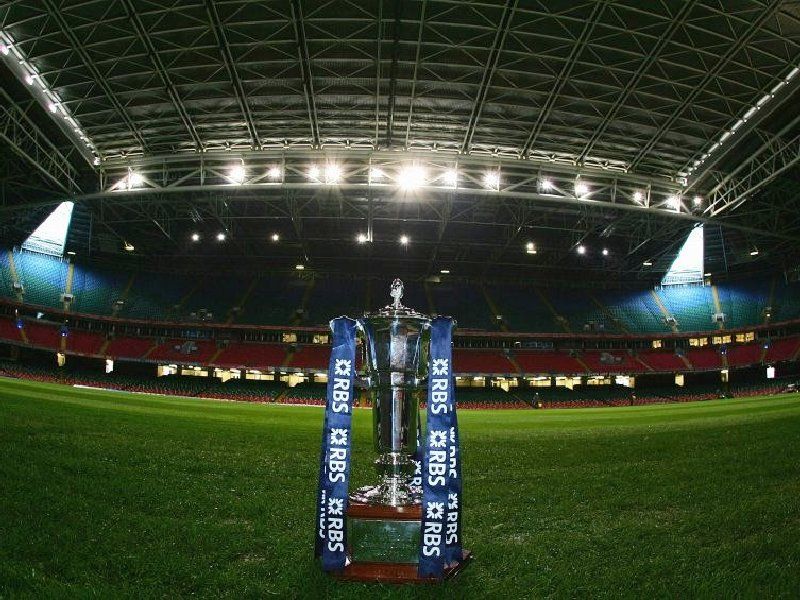
Six Nations Rugby Championship Trophy

Each year, the RBS Six Nations Championship Trophy is presented to the winning team. Below are some interesting facts regarding the trophy:

The idea of a Trophy for the Six Nations Championship was first thought of by the Earl of Westmorland, and was first presented in 1993 to France (the winners that season). It is held in trust by the Six Nations Championship Trophy Trust.

The Trophy is made of 200 ounces of sterling silver and is insured for £55,000. It was designed by James Brent-Ward, a silversmith designer, and made by eight craftsmen at the London silversmith firm William Comyns. The inside of the Trophy was originally silver, but it became so tarnished from repeated fillings with champagne that it has been lined with 22 carat gold to protect it.

There are fifteen sides to the Trophy, representing each player, and three handles representing each official ie the referee and two touch judges. Around the wooden base of the Trophy is the emblem of each of the six national unions.

The handle, or finial, on the lid is interchangeable and represents the current champions. The current champions are Wales so at the moment the finial is the one decorated with Prince of Wales' feathers. The finials of the five challenging teams are kept in a hidden drawer in the plinth throughout the Championship.

The capacity of the Trophy is exactly five bottles of champagne, one for each of the original Five Nations, and the trophy has a lip at the rim, designed so that it is easy to drink from.

Six Nations Championship Trophy Trust

Rugby Six Nations - History of Victories

Played annually, the format of the Championship is simple: each team plays every other team once, with home field advantage alternating from one year to the next. Two points are awarded for a win, one for a draw and none for a loss. Unlike most other rugby union competitions the bonus point system is not used.

Victory in every game results in a 'Grand Slam'. Back to back Grand Slams have been achieved on five occasions, by Wales in 1908/1909, by England in 1913/1914, 1923/1924 and 1991/1992 and France in 1997/1998. England holds the record for the number of Grand Slams won with 12, followed by Wales with 10, France with 8, Scotland with 3 and Ireland with 1.


Victory by any Home Nation over the other three Home Nations is a 'Triple Crown'. The Triple Crown has twice been won on four consecutive occasions, once by Wales in 1976, 1977, 1978, and 1979 and once by England in 1995, 1996, 1997, and 1998. England hold the record for the number of Triple Crowns won with 23, followed by Wales with 20, Scotland with 10 and Ireland with 9. Although this achievement has long been a feature of the tournament, it was not until 2006 that a physical trophy, commissioned by the Royal Bank of Scotland, was awarded.

If a nation at the end of the tournament has lost every match it is said to have the Wooden Spoon.

In 2005 Wales won the Grand Slam, becoming the first team ever to win a Grand Slam playing more games away than at home.

In 2006, France won the competition on points difference over Ireland. Ireland received the consolation prize of the Triple Crown Trophy, presented for the first time that year. Italy once more collected the Wooden Spoon. For the first time since 2000, Scotland won the Calcutta Cup.

In 2007, France again won on points difference, after four teams had at least a mathematical chance of topping the table going into the final week. The Italians had their first away win of the tournament beating Scotland in Edinburgh. Scotland won the wooden spoon and Ireland won the Triple Crown for the second straight year and third time in four years.


In 2008 Wales won the Grand Slam with a 29-12 win against France in Cardiff, having only conceded two tries in the championship, beating England's previous record of four tries conceded.

Six Nations Championship - History

In 1871, England and Scotland played the first rugby union international.After 12 years of occasional friendly matches between the teams, the inaugural Home International Championship, comprising England, Ireland, Scotland and Wales was played in 1883. England won the first series, along with a Triple Crown. Up until 1893, England and Scotland were the only champions, with Wales winning their first title that season. Ireland won their first title the following season. more wikipedia>>
Four becomes five
France did not join the fray until 1910 and, despite their later dominance, they struggled at first to achieve any notable success. They did however, coin the phrase 'five nations'. In their first four years of entry, the French won just one game - a one point victory over Scotland in 1911. more>>

Six Nations Rugby Chamionship
France were the first winners of the new trophy, followed by Wales and then England. Scotland's first success came in season 1998-99; Ireland have yet to win it. Scotland was the last nation to win the Five Nations Trophy as such because Italy joined the competition in 2000 and the tournament became known as the "Six Nations Championship". England were the first nation to win the trophy under the new format, winning the 200 competition. The importance of the competition has decreased slightly since the introduction of the Rugby World Cup, but the long-standing rivalries between teams mean that it remains a passionate and fiercely contested prize.